Medical Cannabis Policy or Cannabis Liberalization? Thailand's Ongoing Debate
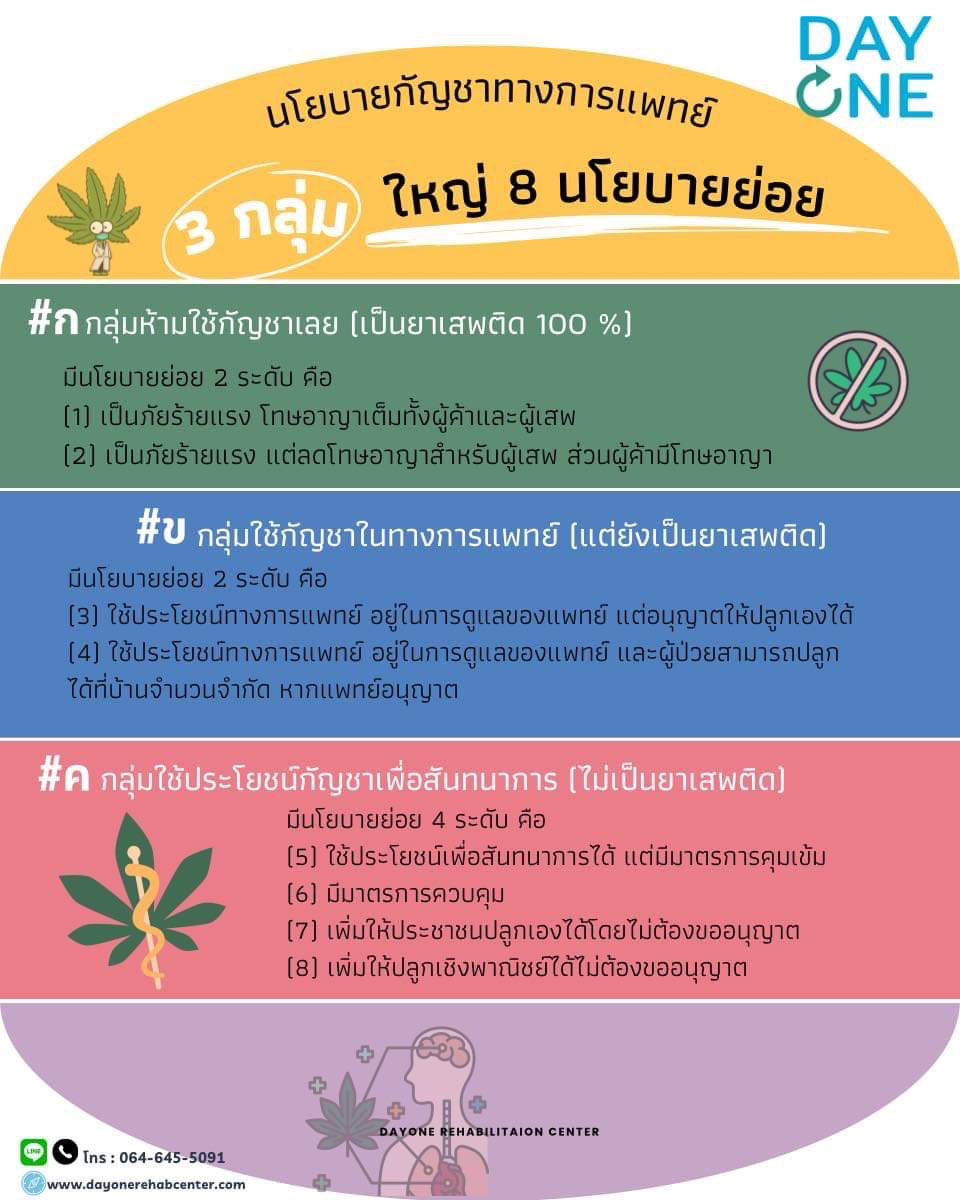
3 Broad Categories, 8 Policy Options: Medical Cannabis or Cannabis Liberalization?
On April 20, 2023, public debate reignited around Thailand’s current cannabis policy, which many argue has become far too permissive. Advocates of medical cannabis have spoken up, pointing to its benefits for improving patients’ quality of life. Chuwit Kamolvisit, a prominent public figure, expressed support for medical cannabis while opposing full liberalization — a debate that maps onto the following breakdown of cannabis policy options in Thailand.
Cannabis policy can be grouped into 3 broad categories with 8 specific levels:
(A) Full prohibition (cannabis remains 100% classified as a narcotic), with 2 sub-levels:
(1) Cannabis is treated as a serious danger, with full criminal penalties for both sellers and users
(2) Cannabis is treated as a serious danger, but criminal penalties are reduced for users while sellers still face full criminal penalties
(B) Medical use permitted (cannabis remains classified as a narcotic), with 2 sub-levels:
(3) Cannabis may be used medically under a physician’s supervision, with patients permitted to grow their own
(4) Cannabis may be used medically under a physician’s supervision, with patients permitted to grow a limited amount at home if authorized by their doctor
(C) Recreational use permitted (cannabis is no longer classified as a narcotic), with 4 sub-levels:
(5) Recreational use permitted, but under strict controls
(6) Recreational use permitted, under moderate controls
(7) The public may grow cannabis themselves without a permit
(8) Commercial cultivation is permitted without a permit
After delisting cannabis, the Ministry of Public Health — signed off by the Minister of Public Health, then leader of the Bhumjaithai Party — effectively adopted policy group (C): cannabis could be used recreationally, since it was no longer classified as a narcotic.
While the Ministry of Public Health has continually stated that recreational use was never the intended goal, the policy that was actually implemented sits at sub-level 8 — only light controls, with the public and businesses alike permitted to grow cannabis without a permit and without quantity limits.
The Psychiatric Association of Thailand has recommended that the government provide comprehensive public education to minimize the potential harms and social impact, and has called for the government to put concrete regulatory measures and controls in place before delisting cannabis, in order to protect vulnerable groups and ensure the policy delivers genuine medical and public benefit.
This has led Chuwit to propose returning to a medical cannabis policy under physician supervision — policy group B, level 3. Meanwhile, advocates of medical cannabis have pointed to patients who grow their own cannabis and have benefited from it therapeutically, arguing for policy group B, level 4, which allows patients to grow their own cannabis under medical supervision, without opening the door to recreational use. What this shows is that the more people speak up about cannabis’s many medical benefits, the more urgent it becomes for Thailand to roll back its liberalized cannabis policy and move quickly toward a proper medical cannabis framework — so the country can capture two benefits at once:
-
The medical benefits cannabis can offer
-
Closing off the harms that come from recreational use
Where do you think Thailand’s cannabis policy should sit, to minimize the impact on children, young people, and society as a whole?
A major turning point in Thailand’s cannabis liberalization was the removal of every part of the cannabis plant from the list of controlled narcotics (provided THC content does not exceed 0.2%). This delisting took effect without any law or regulatory measure in place to adequately control its use — creating a regulatory “vacuum” that has allowed the cultivation, sale, and consumption of cannabis in Thai society to proceed with little to no rules, increasingly unrestricted and lacking essential safety controls. As a result, it now poses a growing risk to the safety of children and young people, and to patients affected by cannabis use — precisely the groups this policy should have prioritized protecting.
If you or someone close to you is struggling with cannabis dependence and wants to quit, or needs addiction treatment, contact DAY ONE Rehabilitation Center. We take a holistic approach to treatment, restoring physical, mental, and social wellbeing through a range of treatment methods.
For more information, please contact us at:
99/1 Moo 6, Si Chula, Mueang Nakhon Nayok, Nakhon Nayok 26000, Thailand
+66 64-645-5091 [email protected]
Mon – Sun: 9:00 AM – 5:00 PM (ICT)