Where Thailand's Political Parties Stood on Cannabis Policy
“Cannabis Liberalization Policy”
Types of drugs and the penalties for drug use
With an election approaching, each political party has continued putting forward a range of policies. Here we look at where each party stood on policies related to cannabis and drugs, and what direction each might take if it formed the government.
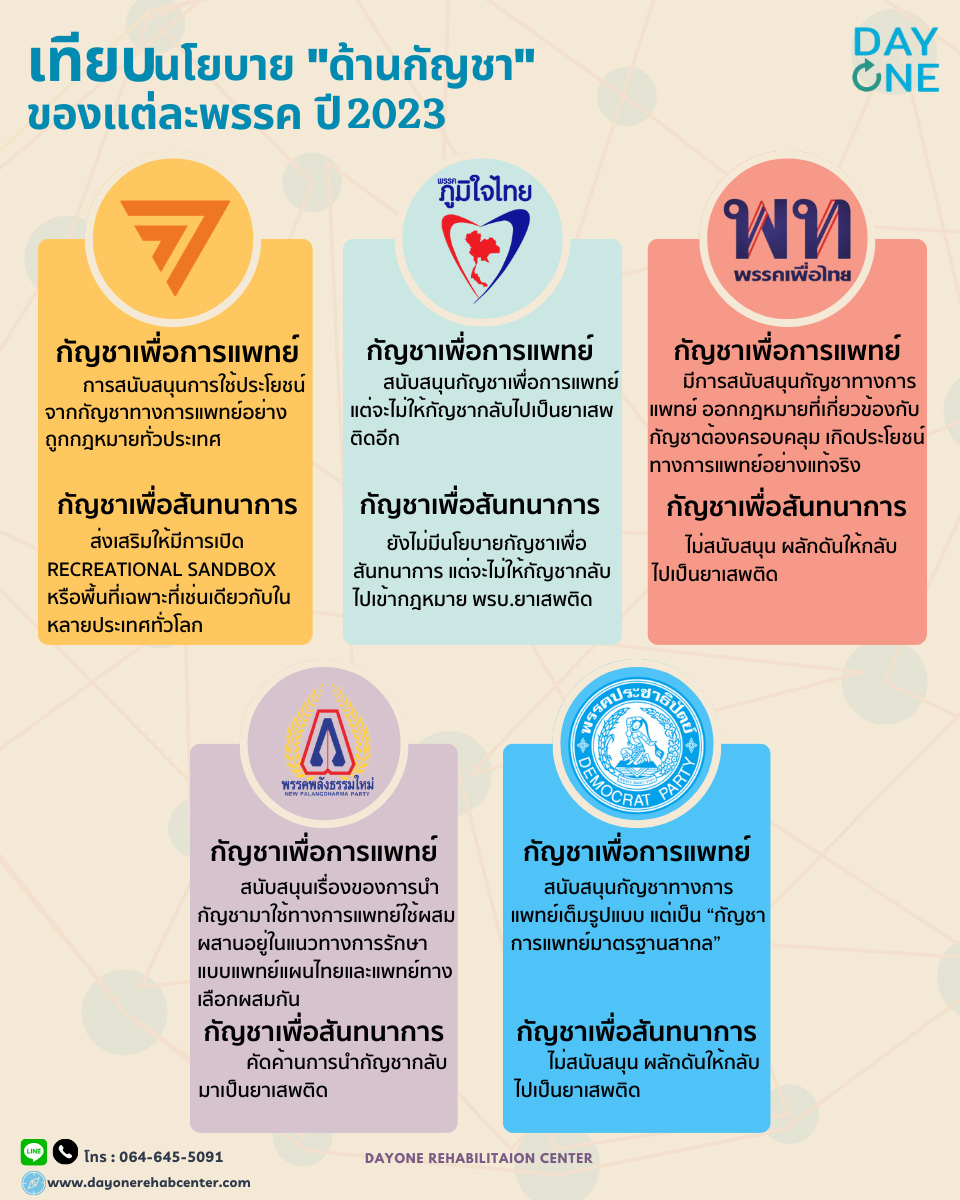
Move Forward Party
-
Recreational cannabis: The party’s approach promotes opening a “recreational sandbox” — designated areas, similar to those used in several countries worldwide — and pushing for regulation to govern cannabis use as quickly as possible, in order to end uncontrolled cannabis use. Under this approach, cannabis would remain classified as a narcotic, with appropriate regulatory law in place.
-
Medical cannabis: The party supports legal access to medical cannabis nationwide, and would work to amend the draft cannabis law into legislation that properly regulates cannabis use — enabling legal medical use that benefits patients and the public, while using this legislation to stop the current state of uncontrolled cannabis use.
Bhumjaithai Party
-
Recreational cannabis: No policy yet on recreational cannabis, but the party would not allow cannabis to be reclassified back under the Narcotics Act.
-
Medical cannabis: Supports medical cannabis, but would not allow cannabis to be reclassified as a narcotic again, and would continue pushing for cannabis legislation to benefit the public as before.
Pheu Thai Party
-
Recreational cannabis: Does not support it, and would push to reclassify cannabis as a narcotic again.
-
Medical cannabis: Supports medical cannabis, with the position that related legislation must be comprehensive and deliver genuine medical benefit.
New Palang Dharma Party
-
Recreational cannabis: Opposes reclassifying cannabis as a narcotic, but does not support free/recreational cannabis use.
-
Medical cannabis: Supports using cannabis for medical purposes, viewing cannabis as something that should serve medicine, the economy, and society — with its medical use forming part of Thai herbal medicine, integrated into traditional Thai and complementary medicine practice.
Democrat Party
-
Recreational cannabis: Opposes reclassifying cannabis as a narcotic, but does not support free/recreational cannabis use.
-
Medical cannabis: Fully supports medical cannabis, but insists on “internationally standardized medical cannabis,” requiring clear, comprehensive legislation.
From the above, we can see that while parties may share similar-sounding cannabis policies, the details differ significantly. Drawing on multiple sources, including psychiatrists, many still view cannabis as more harmful than beneficial if decontrol continues, and there have been calls for the Ministry of Public Health to reconsider removing cannabis from the narcotics list, since cannabis remains a narcotic substance. The Narcotics Control Board approved a Ministry of Public Health notification specifying substances classified as Category 5 narcotics (approved January 25, 2022, effective June 9, 2022), which meant that cannabis plants and flower buds were no longer classified as narcotics. This led to the buying, selling, growing, using, and consuming of cannabis becoming largely unregulated — allowing children, young people, and the public to buy and use it recreationally, which has led to health problems both for users themselves and for others affected by users, as well as social problems, mental health problems, and crime, along with long-term harm to the public health system and to the public more broadly — and particularly to the safety of children, young people, and other vulnerable groups, who face a greater risk of serious health effects from cannabis than other groups and should therefore be protected, with access limited as much as possible.
Let’s take a basic look at the categories of drugs and the penalties for drug use, to help us understand drugs better.
Legal Classification of Drugs
Thailand’s Narcotics Act (B.E. 2522 / 1979) divides drugs into 5 categories:
Category 1 narcotics are the most dangerous drugs, such as heroin, LSD, amphetamine (yaba), and ecstasy (also known as “love drug”).
Category 2 narcotics can be used for medical benefit, but only under a physician’s supervision and only when necessary. No one may manufacture, import, or export Category 2 narcotics; possession for sale or general possession requires a license. Examples include opium, morphine, cocaine, and methadone.
Category 3 narcotics are pharmaceutical preparations containing a Category 2 narcotic as an ingredient, under criteria announced by the Minister in the Royal Gazette. No one may manufacture, sell, import, or export Category 3 narcotics without a license — except for medical practitioners, or first-class dental practitioners, dispensing to their own patients, or first-class veterinary practitioners, dispensing to animals under their treatment or care. Using these substances for other purposes, or for recreational use, carries penalties. Examples of this category include cough medicine containing codeine, anti-diarrheal medicine containing opium, and injectable painkillers such as morphine and pethidine, which are extracted from opium.
Category 4 narcotics are the chemicals used to manufacture Category 1 or Category 2 narcotics — such as acetic anhydride, used in illicit heroin production, anthranilic acid, and 12 other psychoactive substances that can be used to manufacture ecstasy and yaba.
Category 5 narcotics are drugs that don’t fall under Categories 1 through 4, including all parts of the cannabis plant, all parts of the kratom plant, and magic mushrooms, among others.
The Harms of Drug Addiction
Harm to body and mind: damages the nervous system and brain, deteriorates mental health, causes depression, anxiety, disorientation, and drug-induced psychosis, destroys personality, causes a loss of self-awareness and consciousness, wastes the body away with fatigue, and damages organs, leading to complications, frequent illness, and a higher risk of accidents due to impaired muscle control and nervous system function.
Harm to the family:
- Loss of responsibility toward family and relatives
- Financial loss from money spent on drugs and treatment
- Loss of family security — unable to work, no longer trusted by others, and bringing danger to children, spouse, and relatives
Harm to society:
- A danger to society
- A higher likelihood of turning to theft-related crime due to high expenses
Harm to the public and the nation:
- A danger to others, communities, and the country, increasing national spending on prevention, suppression, and treatment
- Damaging effects on the country’s economy and culture
If you or someone close to you struggles with cannabis dependence and wants to quit, DAY ONE Drug Treatment Center offers a holistic approach to treatment. As a drug treatment and rehabilitation center for people struggling with alcohol, drugs, and gambling, we support recovery across the physical, mental, and social dimensions of health, using a range of treatment methods.
Contact Us
For more information, please contact us at:
- 99/1 Moo 6, Si Chula, Mueang Nakhon Nayok, Nakhon Nayok 26000, Thailand
- +66 64-645-5091
- Mon – Sun: 9:00 AM – 5:00 PM (ICT)